
AI roleplay for sales training: how it works, what it fixes and how to roll it out
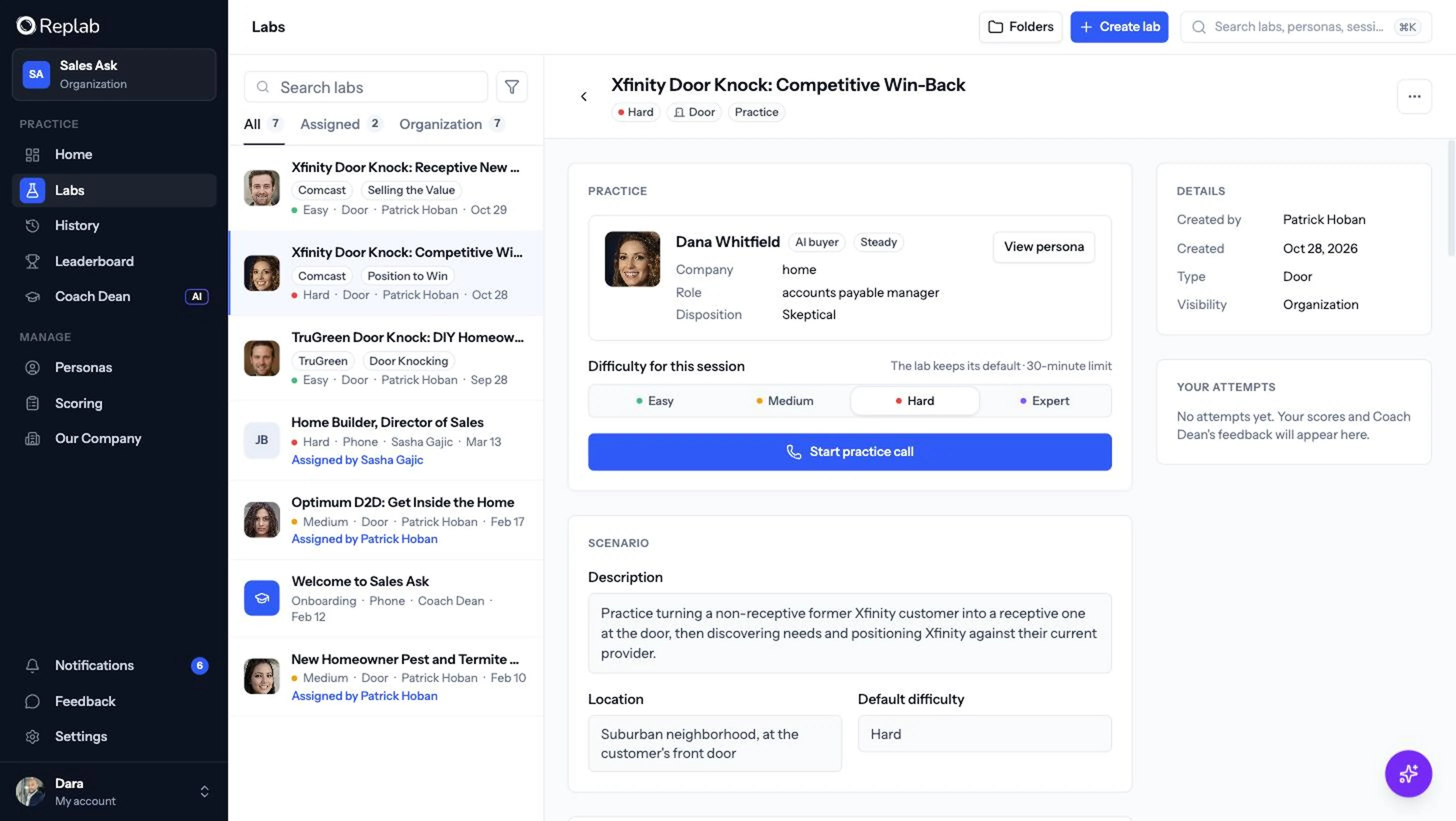
AI roleplay earns its place in a sales training program in the weeks after the workshop, when reps have heard the pitch once and have not yet said it to a customer under pressure. Used well, it means two or three scored attempts at one scenario per rep per week, a pass mark the team agreed on, and a manager who opens the lowest score first. Below is the rollout we recommend, the scenarios to build before any others, and the three ways teams get it wrong.
Where it fits: after the workshop, before the customer
Keep the workshop. The kickoff day where a trainer walks through the process, the pricing and the objections does something software cannot: it gets the whole team in one room agreeing on what a good call sounds like. What the workshop cannot do is survive contact with the following Tuesday.
The forgetting research is old and it holds. Murre and Dros replicated Ebbinghaus's forgetting curve in PLOS ONE in 2015, with one subject spending 70 hours learning and relearning lists. After 31 days, savings on relearning were about 4%, meaning almost everything had to be learned again. One person memorising syllables is a long way from a rep learning a financing pitch, so I would not wave that figure at a sales VP. The shape of the curve is the point: most of the loss happens in the first day or two, and anything you want a rep to keep has to be used again inside that window. Hyperbound's onboarding page makes the same claim in plainer terms, that generic onboarding content is forgotten within 30 days, though that is a vendor talking about its own product.
So the gap AI roleplay fills is the one between the training day and the live call. The four to twelve weeks where a new hire has the words in a binder and no safe place to say them out loud. A manager fills that gap only when the manager is free, which in a branch with eight reps and a service board is roughly never. An AI customer is free at 7am and a rep can fail against it four times before breakfast with nobody watching.
Practice does happen when you make it available. On Second Nature's customer page, SAP's PreSales readiness lead says the team was "shocked to find that people in the pilot did an average of four complete sessions of practice." Four is not a lot. It is four more than most reps get from a manager in a month.
The three moments to practise first
Build three scenarios before you build thirty. The temptation with a library of 40 ready-made customers is to assign all of them, and the result is a team that has practised everything lightly and nothing well. The three moments below are where deals are lost in nearly every home services, retail and branch sales process we have seen, and each one can be scored on something concrete.
Price is first because it is the moment reps dread and the one managers most often skip in a roleplay because it feels awkward. The customer hears the number and says it is too much. The score is whether the rep holds the price, explains what it includes, and offers a payment option before dropping anything. Coolforce Heating & Cooling, a RepLab customer, reports finance uptake rose to 38% from 12% after its techs started practising this exact moment; that is Coolforce's own number from our customers page, with no control group behind it, but it is the moment that moved.
The top objection is second, and it is specific to you. Pull it from your last twenty lost deals or from whatever your reps complain about most in the truck. "I need to talk to my wife." "I have another quote." One objection, scored on whether the rep acknowledged it, asked a question before answering it, and brought the conversation back to the decision.
The next step is third and the most neglected. A call that ends with "I'll send you something" is a call that did not end. Score whether the rep proposed a specific next step with a date, and whether the customer agreed to it.
| Scenario | Who practises it | What to score |
|---|---|---|
| Price: customer says the quote is too high | Every rep in the first two weeks; new hires before certification | Price held or explained before any discount; what the price includes stated; payment or financing option offered |
| Top objection: your single most common lost-deal reason | Every rep; sales managers run it once themselves | Objection acknowledged; a question asked before the answer; conversation returned to the decision |
| Next step: closing the call with a commitment | New hires and any rep with a long quote-to-close time | Specific next step proposed with a date; customer agreement heard; recap of what was agreed |
| Discovery (add in month two) | Reps with low average ticket | Three qualifying questions asked before any product talk; customer's own words used in the pitch |
| Hostile customer (add in month three) | Service and support agents; senior reps | Tone held; complaint restated; resolution offered without over-promising |
A 30-60-90 day rollout
The plan below assumes a team of 10 to 50 reps, one or two managers, and one person who owns the scorecard. Setup on RepLab takes about a day (kickoff is a 30-minute call to load scripts, the scorecard and the hardest calls, and most teams are practising within a week), so the schedule is about habits and management.
The first 30 days exist to answer one question: is practice happening? Do not look at scores for the first two weeks except to check that the scorecard makes sense. Look at attempts. If a rep has done zero by day ten, the problem is not the rep.
Days 31 to 60 are where the scorecard gets argued over, and that argument is the most useful thing in the whole rollout. A manager will say a rep scored 85 and the call was terrible. Good. That means a criterion is missing or weighted wrong. Fix it, re-score, and the number starts meaning something.
By day 90 the program should run without the person who set it up: certification before go-live, a weekly assignment, and the lowest heatmap cell as the standing item in the Monday coaching call.
| Window | What to set up | What to measure | Owner |
|---|---|---|---|
| Days 1 to 30 | Three scenarios (price, top objection, next step); scorecard loaded with weights agreed by sales and training; every rep signed in via SSO; two attempts per rep per week assigned | Attempts per rep. Target: 100% of reps with at least one attempt by day 7, two per week after that | Sales manager |
| Days 31 to 60 | Pass mark set per scenario (RepLab defaults to a score goal, 70 in its example; set yours from the top third of week-one scores); certification required before new hires take live calls; scorecard revised from manager disagreements | Pass rate per scenario; number of scorecard edits made; first new hire certified | Training lead with sales manager |
| Days 61 to 90 | Discovery and hostile-customer scenarios added; weekly coaching call opens with the lowest heatmap cell by team; scores synced to the CRM or dialer | Lowest skill score by team, month over month; ramp time of the first cohort certified under the program versus the last cohort before it | Sales leader |
How managers use the scores: coach the lowest number, not the session
The score is not the coaching. The score tells the manager where to spend the ten minutes.
When a manager listens to a whole session instead, they notice six things, mention four, and the rep remembers one, usually the easiest. It feels thorough and produces almost nothing. Opening the heatmap, seeing that a rep's Price score is 62 while everything else sits in the 80s, and spending the whole conversation on how they handle "that's too much" produces a change you can measure next week.
RepLab's skill heatmap shows five columns (Opening, Discovery, Price, Financing, Close) by rep, team and location over the last 30 days, and flags each cell Ready or Slipping. The example on our product page shows Toronto at 92, 88, 85, 83 and 87, and Phoenix at 79, 70, 62, 69 and 71. A regional manager looking at that does not need to listen to anything from Toronto. Phoenix's 62 on Price is the coaching call, and it is a team conversation, since the whole location is low on it.
Three rules. The manager opens the lowest cell, not the latest session. The manager reads the time-stamped note on the lowest criterion before the call, so it starts with "at 2:40 you dropped the price before the customer finished the objection" instead of "so how do you feel it went." The manager assigns one retry on that one scenario, with the pass mark, and checks it cleared before the next one-to-one. Second Nature's customer page quotes an enablement lead saying delivery improved 48% between a rep's first practice and their best practice within days, across almost 2,000 people; it is a vendor-published figure and the measure is the tool's own score, so read it as the size of the practice effect on practice, not on revenue.
What none of this tells you is whether a 90 in practice becomes a better call with a customer. That needs the same scorecard on real recorded calls, which on RepLab is a separate product and a separate rollout.
What it costs in time, and the three mistakes
Budget 20 to 30 minutes per rep per week. That is two or three attempts at one scenario plus reading the feedback, and it is the amount we see sustained past month three. Teams that assign an hour get an hour in week one and nothing by week five. Managers need about 15 minutes per rep per week on top: five to read the heatmap and the lowest note, ten for the conversation. For a manager with eight reps that is two hours a week they were mostly already spending on one-to-ones, without a number in front of them. Pimlico Plumbers reports it trained more than 250 engineers on RepLab without a single classroom session, which is the saving on the other side of the ledger; it is Pimlico's own claim from our customers page.
Now the mistakes, in the order we see them.
Too many scenarios. A team that assigns twelve scenarios in week one has made practice feel like a compliance module, and compliance modules get done at 4:55pm on Friday with the sound off. Three scenarios, two attempts a week each, for a month. Add one a month after that and retire one that everyone passes.
The vendor's scorecard. Every platform ships with a rubric and it is always easier to keep. If your process says offer financing before any discount and the rubric does not know what financing is, the score is noise, and your managers will learn to ignore it within a month, which kills the program. Load your scorecard on day one even if it is six lines in a spreadsheet. You will revise it by day 45 anyway.
No pass mark. Without a threshold the score is a number reps look at once. A pass mark turns it into a gate: no live calls until you have cleared 75 on Price. It also forces the retry, and the retry is where the learning is. Set it from data. Run every rep through the scenario once, take the top third of scores, and set the mark at the bottom of that band. Raise it a quarter later.
There is a fourth mistake I cannot give you a clean fix for: senior reps who refuse to practise because they are already hitting number. Some teams have the top performer record the model attempt everyone else is scored against, which turns refusal into status. It works about half the time.
How RepLab does it
RepLab is an AI roleplay platform for sales and service teams in stores, branches, call centers and the field. Reps talk out loud, in a browser on desktop or mobile, to an AI customer built from the team's own scripts, pricing sheets or a recording of a top rep, or chosen from 40 or more ready-made scenarios. The customer has a budget, a mood and objections, interrupts, asks follow-ups and varies between sessions, and you choose the first objection it raises. Most teams build their first custom customer in under ten minutes.
Every attempt is scored 0 to 100 on your own scorecard and weights, with each criterion marked met or missed, time-stamped notes and one suggestion for next time. Managers set a score goal per scenario and reps can retry until they clear it, including outside work hours. Managers see readiness by rep, team and location, the 30-day skill heatmap with Ready and Slipping flags, a leaderboard, and can certify reps before they take live calls. Scores, readiness and certifications sync to Salesforce, HubSpot, Pipedrive, Aircall, JustCall, ServiceTitan, Housecall Pro and Jobber.
Rollout follows four steps: a 30-minute kickoff to load scripts, the scorecard and the hardest calls; RepLab drafts the first scenarios for you to adjust; reps sign in with SSO; you set a passing score per scenario. Most teams are practising within a week of kickoff. Customers report 58% shorter new-hire ramp at Alliance Medical (12 weeks to 5), 3x close rate on competitive deals there, 31% higher quoted job value at Coolforce and 19% higher closing rate at OGC Group. Those are customer-reported figures without control groups.
RepLab supports English, Spanish and French. Security: SOC 2 Type I, GDPR, SSO and MFA, TLS in transit, hosted on AWS, and conversations never train outside AI models. Pricing is quoted per rep seat after a 30-minute demo, across Team, Growth and Enterprise plans, with managers and admins included and a 10-seat minimum. Anyone can run a free roleplay against an AI customer before booking a demo.
Frequently asked questions
Does AI roleplay replace sales training workshops?
No. It replaces the gap after the workshop, the weeks when reps have heard the process once and have not yet used it with a customer. Keep the workshop, then assign scored practice on the three moments that lose deals.
Which scenarios should a sales team practise first with AI roleplay?
Price (the customer says it is too much), your single most common objection, and the next step (ending the call with a dated commitment). Build those three before anything else and add one scenario a month after that.
How much time does AI roleplay sales training take per rep?
Plan on 20 to 30 minutes per rep per week: two or three attempts at one scenario plus reading the feedback. Managers need about 15 minutes per rep per week to read the lowest score and hold the coaching conversation.
How should managers use AI roleplay scores?
Open the lowest score, not the latest session. Read the time-stamped note on the weakest criterion, coach that one thing, assign a retry with a pass mark and check it cleared before the next one-to-one.
What pass mark should we set for AI role play training?
Set it from data. Run every rep through the scenario once, take the top third of scores and put the mark at the bottom of that band. Require it before new hires take live calls, and raise it a quarter later.
Written by the RepLab team. Updated November 2026. RepLab is an AI roleplay platform for sales and service teams in stores, branches, call centers and the field, scored on your own scorecard.