
What is an AI roleplay platform? How AI sales roleplay works in 2026
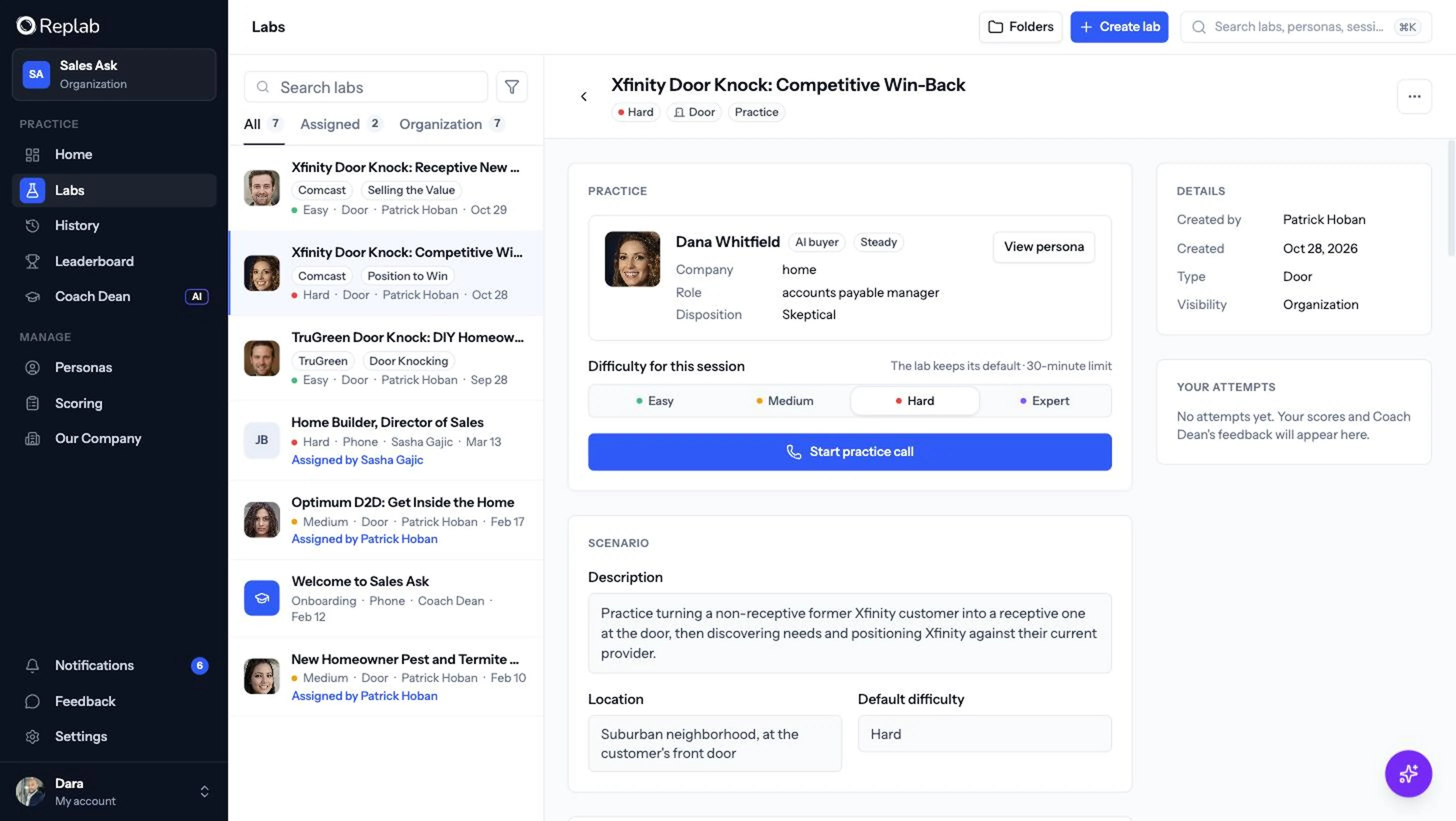
An AI roleplay platform is software that plays the customer so a rep can rehearse a sales or service conversation, then scores the attempt and tells the rep what to fix. The rep talks (or types, or sits on video) with a simulated buyer that objects, interrupts and changes its mind, and a manager gets a report without sitting in on the call. In 2026 the category spans voice-first tools like RepLab and Hyperbound, avatar and video tools like Second Nature and Yoodli, and contact-center programs built in house, so the word covers several quite different products.
How AI sales roleplay works, step by step
Every platform in this category runs the same loop: build a customer, run the conversation, score it, hand the rep feedback, roll the results up to a manager. The vendors differ on the medium and on who writes the scoring rules.
The simulated customer is the core. On RepLab you upload a script, a pricing sheet or a recording of a top rep and the platform turns it into a customer with a budget, a mood and the objections your reps hear most; you can also just describe the customer and let it draft the persona. Hyperbound's home page says building a first bot and scorecard takes under ten minutes, while its persona setup for customers takes two weeks on average. Second Nature runs video avatars for scenarios like discovery calls, objection handling and cold calls, and one of its customers says they could create any scenario in 15 minutes. Yoodli builds learning journeys from a prompt, with personas that each draw on their own set of documents. All four run the session live: the rep speaks (voice, or video with an avatar) and the AI responds in real time, interrupting and asking follow-ups. RepLab's product page says each session varies, so a rep cannot memorise the call.
Scoring is where products diverge most. RepLab scores each attempt 0 to 100 against the company's own scorecard and weights, marks each criterion met or missed, and attaches time-stamped notes plus one suggestion for next time. Hyperbound's example scorecard checks items like "Permission based opener?" and adds a written "Why were you scored this way?" explanation. Yoodli scores on criteria such as objection handling, empathy or clarity and returns strengths plus one area to work on. Second Nature's feedback can flag, mid-session, when a rep launches into solutions too early.
The manager layer is what makes this a platform rather than a practice toy. RepLab shows readiness by rep, team and location with a skill heatmap across opening, discovery, price, financing and close, flags each skill as Ready or Slipping, and lets managers certify reps before they take live calls. Yoodli Measure shows progress by goal and improvement by group. Hyperbound's Perform product scores real recorded calls on the same scorecards, so practice scores and live-call scores sit side by side. That last point matters more than it sounds, and I'll come back to it.
Who uses it, and what it replaces
The buyers are sales teams first, then service and contact centers, then field and retail teams. Hyperbound lists B2B SaaS, logistics, banking and B2B call centers. Second Nature names insurance, telecom, financial services, education and customer support, with escalation and complaint scenarios for support staff. Yoodli's customers include Google Cloud (15,000+ sellers certified, per Yoodli), Snowflake, Mayo Clinic and the Government of El Salvador, which used it for doctors. RepLab targets sales teams, contact centers and BPOs, customer support and field technicians in telecom, financial services and insurance, healthcare and home services.
What it replaces is the manager-led roleplay and the ride-along. A manager roleplaying one rep at a time is the most expensive hour in a sales org, it only happens when the manager is free, and the manager grades on feel. Shadowing a top rep teaches by osmosis and only covers the calls that happened to come in that day. IntouchCX, a contact-center outsourcer, wrote up a pilot at a large US retailer where new agents practised voice conversations against AI personas and got an immediate scorecard on empathy, listening and call control, in place of static scripted exercises. New hires who used it averaged 7% higher CSAT than non-users in their first four weeks, QA scores rose 4%, and they reached the 400-second handle-time benchmark by week 11. Those are IntouchCX's own numbers from a single pilot, not an independent study, but they show the shape of what buyers are after: compress the gap between classroom and live calls.
None of these tools replaces the manager. They replace the manager's time spent being the customer, and they give the manager a number to coach from.
Does practice actually work? What the evidence says
The honest answer is that the strongest evidence comes from outside sales, and the sales evidence is mostly vendor-reported. Both are worth reading.
The best-controlled work is medical. A 2021 meta-analysis in Annals of Surgery (Mazzone, Puliatti, Gallagher and colleagues) pooled 12 randomised, blinded trials of proficiency-based progression simulation training, where trainees practise against a benchmark and must hit it before moving on. Trainees who practised that way made about 60% fewer procedural errors (ratio of means 0.40, 95% CI 0.30 to 0.54) and were far more likely to reach the proficiency benchmark (odds ratio 6.92). The authors flagged heterogeneity and possible publication bias, and these were surgeons, not closers. Still, the mechanism is the same one AI roleplay platforms sell: repeat a task against a fixed standard with immediate, objective feedback, and do not advance until you clear the bar. RepLab's "retry until your score holds" model and its Score goal setting are a direct copy of that design.
The sales-specific numbers come from vendors and their customers. Second Nature publishes work by Dr. Johannes Habel of the University of Houston with United Rentals, analysing practice data from a roughly 6,000-person sales org; it reports revenue gains of 7% to 30% by segment among reps who practised more and scored higher, and describes these as correlations rather than causal effects. Second Nature also claims 34% shorter ramp and 46% more deals closed on average across customers, and that GoHealth cut onboarding from nine weeks to five. Yoodli reports RingCentral cut agent certification time 90% and Clari saw 36% skill improvement per goal. Hyperbound quotes a Klaviyo leader saying more reps hit quota in 2026 than 2025, with no number attached. RepLab reports 58% shorter new-hire ramp at Alliance Medical (12 weeks to 5), 3x close rate on competitive deals there, and 31% higher quoted job value at Coolforce.
Treat every one of those as a vendor claim. None I could open includes a control group. What they do show, consistently, is that the organisations that see results are the ones that made practice mandatory, scored it, and tied it to certification. The tool is the easy part.
What to look for when buying one
Start with the scorecard, because it decides whether the number means anything. A platform that grades on its own generic rubric tells you how well a rep performed against the vendor's idea of a good call. A platform that grades on your criteria, with your weights, tells you whether the rep did what you'd coach them to do. Ask to see your own scorecard loaded before you sign.
Then check the medium against where your reps actually sell. A B2B SaaS team on Zoom all day can practise on video. A technician at a kitchen table, a branch rep across a desk, or an agent on a headset needs voice, and needs it to feel like the real thing: interruptions, mood changes, a customer who says "that's too much" halfway through the pitch. Hyperbound offers 25+ languages, Second Nature 30+, RepLab three (English, Spanish, French). If you have a Quebec branch or a Spanish-speaking crew, that line item matters more than the demo.
Last, ask what happens after practice. Can managers assign scenarios and see who hasn't done them? Does a certification gate exist? Do scores land in the CRM or dialer the team already uses, or in yet another dashboard? Hyperbound and RepLab both pair practice scores with real-call scores (RepLab through its SalesAsk add-on). That pairing is the only way to find out whether a 90 in practice becomes a better conversation with a customer.
| Criterion | Why it matters | What to ask the vendor |
|---|---|---|
| Scoring on your own scorecard | A generic rubric measures the vendor's idea of a good call, not yours | Load our scorecard and weights in the demo. Show the score. |
| Voice realism | Field, retail and phone reps sell by voice; a polite bot teaches nothing | Does the customer interrupt, change its mind and vary between sessions? |
| Scenario build time | If it takes two weeks to build a persona, nobody will build the second one | How long from uploading our script to a rep's first session? |
| Languages | Bilingual branches and crews need practice in the language they sell in | Which languages are live today, for both the customer voice and the scoring? |
| Manager reporting | Readiness by team and location is what a VP acts on | Show readiness by rep, team and location, and a certification gate. |
| Link to real calls | Practice scores only matter if they predict live performance | Can the same scorecard score recorded customer calls? |
| Seat model | Per-rep pricing with managers included is simpler to roll out | Do managers and admins need seats? What is the minimum? |
| Data and security | Reps will say customer names and prices out loud | SOC 2 status, hosting region, and whether our conversations train your models |
Mistakes teams make in the first 90 days
The most common one is buying the library and never building a custom scenario. Ready-made scenarios get a team practising on day one, which is the point of them, but a rep rehearsing a generic discovery call is not rehearsing your price objection or your financing pitch. RepLab says most teams build their first custom customer in under ten minutes. If yours hasn't after a month, the rollout has stalled.
The second is leaving practice optional. Every number in the evidence section above came from a program where reps had to practise, had to hit a score, and could not take live calls or certify without it. Optional practice gets used by the reps who need it least.
The third is grading on the vendor's rubric because it was already there. The fourth is never checking whether practice scores track real-call outcomes, so a year in, nobody can say whether the thing worked. And the fifth is quieter: managers stop coaching because the score exists. The score gives the manager somewhere to start; the ten-minute conversation after it is still the coaching.
| Scoring approach | What it measures | Where it falls short |
|---|---|---|
| Vendor's generic rubric | Broad conversation skills (clarity, empathy, structure) | Does not reflect your process, price points or objections |
| Your scorecard, pass/fail per criterion | Whether the rep did each thing you'd coach | Needs someone to write and maintain the criteria |
| Your scorecard with weights, 0 to 100 | Same as above, with a single number to trend and gate on | Weights need agreement between sales and training up front |
| Practice score paired with real-call score | Whether practice transfers to customers | Requires call recording and the same rubric on both sides |
How RepLab does it
RepLab is an AI roleplay platform for sales and service teams in stores, branches, call centers and the field. Reps talk out loud in a browser to an AI customer built from the team's own scripts, pricing sheets or call recordings, or chosen from 40 or more ready-made scenarios, with difficulty set from friendly to hostile.
Each attempt is scored 0 to 100 on the company's own scorecard and weights, with each criterion marked met or missed, time-stamped notes and one suggestion for next time. Reps can retry until their score clears the goal a manager sets. Managers see readiness by rep, team and location, a skill heatmap, a leaderboard, and can certify reps before they take live calls. Scores and certifications can be sent to Salesforce, HubSpot, Pipedrive, Aircall, JustCall, ServiceTitan, Housecall Pro and Jobber.
It supports English, Spanish and French. Security: SOC 2 Type I, GDPR, SSO, MFA, TLS in transit, hosted on AWS, and conversations are not used to train outside AI models.
Pricing is quoted per rep seat after a 30-minute demo, across three plans: Team, Growth and Enterprise. Managers and admins are included and do not need seats. The minimum is 10 rep seats. Anyone can run a free roleplay against an AI customer before booking a demo, and teams can pilot on their own scenarios and scorecard.
Frequently asked questions
What is an AI roleplay platform in one sentence?
Software that plays the customer so a rep can rehearse a sales or service conversation, then scores the attempt and reports the result to a manager.
Is AI sales roleplay voice, text or video?
All three exist. RepLab and Hyperbound are voice-first, Second Nature uses video avatars, and Yoodli runs on video with an AI persona. Choose the medium your reps actually sell in.
Does AI roleplay training actually improve results?
Controlled evidence comes from medicine, where a 2021 meta-analysis of 12 randomised trials found proficiency-based simulation practice cut errors by about 60%. Sales numbers are vendor-reported: Second Nature cites 34% shorter ramp, IntouchCX a 7% CSAT lift for new hires, RepLab 58% shorter ramp at Alliance Medical. None include a control group.
What does an AI roleplay platform replace?
The manager's hours spent playing the customer one rep at a time, and shadowing that only covers whatever calls came in that day. It does not replace the coaching conversation.
How is AI roleplay scored?
It depends on the platform. Some grade on a generic rubric, others on your own scorecard. RepLab scores 0 to 100 on the criteria and weights you upload, with each item marked met or missed.
Written by the RepLab team. Updated November 2026. RepLab is an AI roleplay platform for sales and service teams in stores, branches, call centers and the field, scored on your own scorecard.