
AI roleplay vs call shadowing: which gets a new rep ready faster?
AI roleplay gets a new rep ready faster, and it isn't close when you count manager hours. Shadowing shows a rep what good looks like, but it costs two salaries per hire, every new hire sees a different set of calls, and nobody can say when the rep is ready. Alliance Medical replaced shadowing with roleplay certification on a 45-rep team and ramp fell from 12 weeks to 5. The better question is how much shadowing to keep, and the answer is a week or two, for context, before the reps start.
The short answer
Shadowing teaches a rep what the job looks like. Roleplay teaches a rep to do the job. A new hire who has watched 40 calls can describe a price objection in detail and still freeze the first time a customer says the number is too high, because watching and answering are different skills and the second one only grows with reps.
That is why the time to ready differs so much. Shadowing has no mechanism for repetition. A rep sees whatever calls happen to come in that week, handles none of them, and gets feedback only if the senior rep has the energy to debrief after each one. Roleplay runs the hard call on demand, 30 times if needed, with a score after each attempt. The rep who has handled the budget objection 30 times in practice is ready in a way the rep who watched it twice is not.
Shadowing still has a place. It is the fastest way to absorb tone, pacing, how the CRM gets used mid-call, and the hundred small things nobody writes in a playbook. Keep it short, put it first, and stop treating it as the training.
What shadowing does well, and where it runs out
Shadowing is good at the things a script can't carry. A new rep hears how a senior rep slows down when the customer gets quiet, watches when they bring up financing, sees which questions get asked before the price comes out. It costs nothing to set up. It builds a relationship between the new hire and someone who can answer questions for the next six months. For the first week or two on the job, nothing beats it.
Then it runs out, and it runs out in three predictable ways.
The first is cost. Every shadowed call is two people doing one person's job. Gareth Walsh, Chief Growth and Marketing Officer at Alliance Medical, put it plainly when describing the way his team used to onboard: "We were essentially paying for two reps to do one job during every onboarding cycle." On a 45-rep team with an 8 to 12 week ramp, that is months of senior selling time handed to onboarding each year, and it comes out of the people who close the most.
The second is consistency. Two reps hired the same week shadow two different senior reps, who handle objections differently and have different habits, some of them bad. One new hire sees three price objections in week one and the other sees none. Neither experience is wrong, but neither is repeatable, and a manager cannot say what either rep has actually been exposed to.
The third is measurement, and this is the one that quietly decides ramp time. There is no score at the end of a shadowed call. Readiness is a feeling the senior rep has, usually expressed as "I think they're about ready," and managers add a buffer week or two because nobody wants a new rep to blow a real opportunity. Alliance Medical's managers could observe only a handful of pitches per quarter, so feedback depended on which meeting they happened to see. A lot of exposure, very little evidence.
What AI roleplay does well, and where it runs out
Roleplay solves the three problems above almost by definition. One rep practices alone, so the senior rep keeps selling. Every new hire runs the same set of scenarios in the same order, built from the same playbook, so two people hired the same week are exposed to the same objections. And every attempt gets a score against criteria the team chose, which means readiness becomes a number with a passing bar instead of a hunch.
There is a reason practice beats watching that goes past convenience. A 2018 study from the University of British Columbia, led by Naznin Virji-Babul and Nicola Hodges and published in Neural Plasticity, split participants into a group that practiced a new task, a group that only watched it, and a control group, then compared them on EEG. The practice group showed the most activity in the premotor cortex. The observation group's responses were slower with more errors. The authors' conclusion was blunt: observation cannot replace physical practice in learning a new skill.
The same pattern shows up in classrooms. Scott Freeman's 2014 meta-analysis in PNAS, covering 250 published studies of STEM courses, found a mean failure rate of 33.8 percent in lecture-based courses against 21.8 percent in courses with active learning, which the authors described as a 55 percent difference in mean failure rates. Listening to an expert is the weaker form of learning. Shadowing is listening to an expert.
One honest caveat from the same body of research: in a 2012 PLoS ONE study by Larssen, Ong and Hodges, watching did help people learn a second task, and observers were better at explaining what they had seen. Watching builds understanding. It just builds it slower and shallower than doing, and it doesn't hold up as well when the person has to act under pressure, which the authors flagged as untested but likely.
Roleplay has limits of its own. The AI customer is only as good as the material it was built from, so a thin script produces a thin buyer. Roleplay cannot teach a rep where the tablet goes during an in-home visit or how a specific branch manager likes the handoff done. And someone has to own the scorecard, because scoring against a generic rubric produces reps who are good at the rubric. These are reasons to keep a short shadowing period and build scenarios from real calls, not reasons to skip it.
Side by side
The table below is the comparison most managers are actually making when they decide how to onboard the next hire. Realism is the one row where shadowing wins outright, and it is the row people overweight, because realism without repetition does not produce a ready rep.
Two rows deserve a note. Manager time under roleplay is not zero, since someone builds the scenarios and reviews the scores, but it is front-loaded and then shared across every hire. And the cost row for shadowing is usually invisible in a budget, because nobody books the senior rep's lost quota against the onboarding line.
| Dimension | Call shadowing | AI roleplay |
|---|---|---|
| Time per rep | Set by how many relevant calls happen to come in; Alliance Medical reported 8 to 12 weeks | Set by the number of scenarios and the passing bar; Alliance Medical reported 5 weeks |
| Manager time | A senior rep or manager on every call, plus debriefs | Scenario build and scorecard setup once, then score review |
| Consistency | Depends on which senior rep and which calls the new hire gets | Every rep runs the same scenarios from the same playbook |
| Measurement | None beyond the senior rep's opinion | A score per attempt against your criteria, with a passing bar |
| Realism | Real customers, real stakes, real pauses | A modeled buyer with your objections; varies by session and can be set friendly to hostile |
| Cost | Two salaries per call for the length of the ramp | Per rep seat, with the senior rep still selling |
| When it works best | The first week or two, for tone, tools and the feel of the job | Weeks two onward, for reps on the hard conversations and certification before the first live call |
How teams combine them
The teams that ramp fastest don't pick one. They sequence them, and the order matters more than the mix.
Shadow for context, early and briefly. A new rep rides along or listens in for the first few days to learn the tools, the handoff, and what a normal day sounds like. This is where shadowing earns its keep and it is enough. If a rep is still shadowing in week four, the program has stalled.
Roleplay for reps, starting in week one and running alongside everything else. The rep works through the scenarios the team gets wrong most often. At Alliance Medical that meant four scenario types: the NHS budget objection, clinical and commercial misalignment, competitive displacement, and contract renewal. The rep repeats each until the score clears the bar. Reps there averaged 4 to 5 sessions a week, most of them started by the rep before a key meeting rather than assigned by a manager.
Certify before the first live call. This is the step most teams skip, and it is the step that replaces the buffer week. Set a list of scenarios and a minimum score, and a rep leads a call alone only after passing all of them. Alliance Medical required new hires to pass 15 scenarios with minimum scores before leading meetings on their own. Managers stop guessing. The rep stops wondering.
The open question is where the bar sits. Too low and certification is a formality. Too high and reps who would have been fine in the field spend an extra week in practice. Alliance Medical's bar fit a six-figure procurement sale; a retail floor or a home services call center will set it differently, and you will probably adjust yours after the first cohort.
How RepLab does it
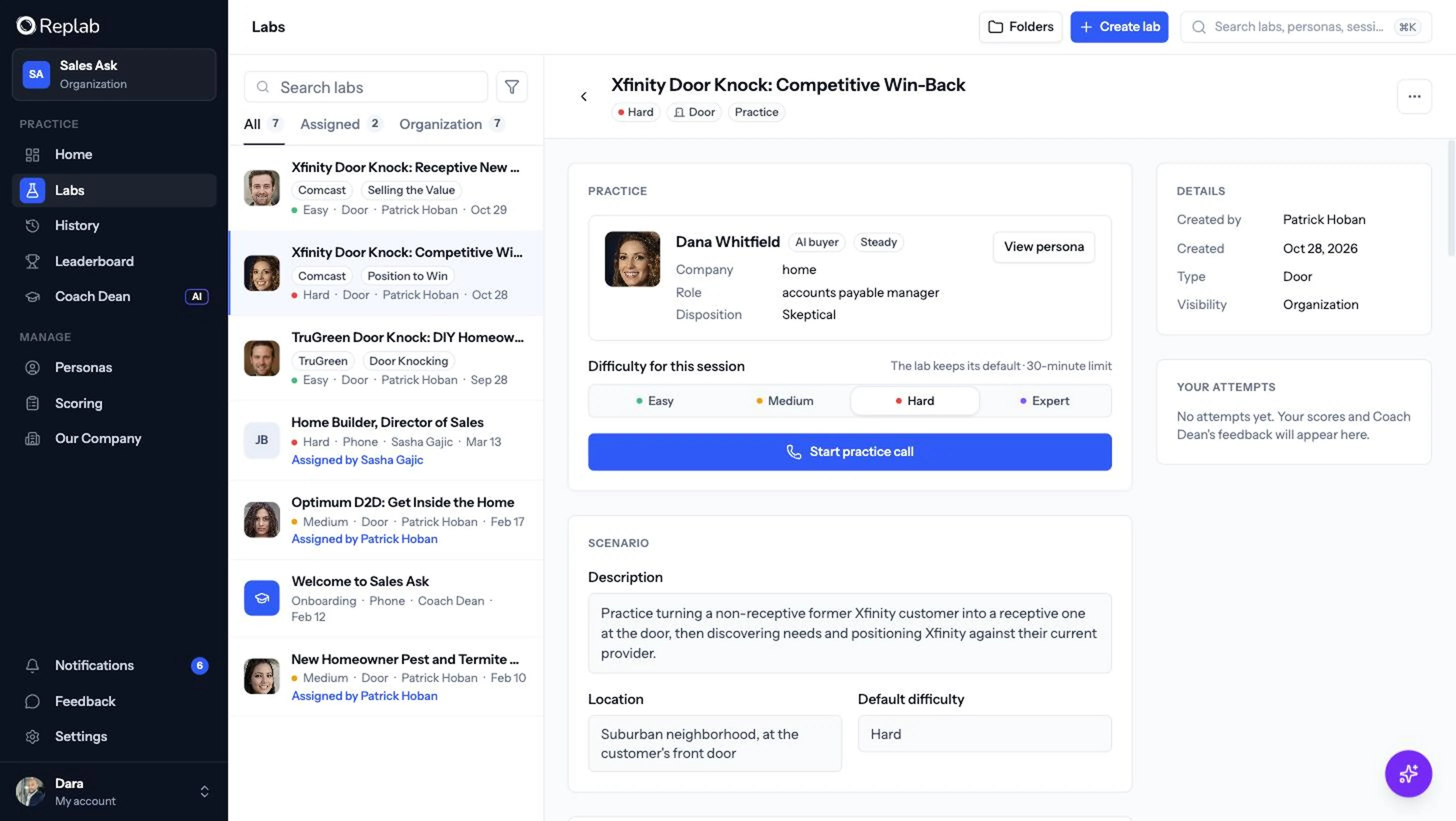
RepLab is built for the sequence above. The AI customer is made from your own material: a team uploads a script, a pricing sheet or a recording of a top rep, and RepLab drafts the persona, the objections and the scoring for editing. The buyer has a budget and a mood, pushes back, interrupts, asks follow-ups and can change its mind. Every session is different, and the rep can set the customer's disposition from friendly to hostile. There are more than 40 ready-made scenarios to start from, and sessions run in a browser in English, Spanish or French.
Scoring is on your scorecard. Each attempt gets a 0 to 100 score against your criteria and weights, with time-stamped notes and one thing to try next time. Reps repeat a session until they reach your passing bar, and managers certify reps before they take live calls. Readiness views by rep, team and location show who is cleared and who is slipping, with a skill heatmap over the last 30 days.
Alliance Medical is the clearest example of the shadowing-to-certification switch. With 45 reps across several countries selling diagnostic imaging to NHS trusts and private hospitals, new hires had needed 8 to 12 weeks of shadowing before running a procurement conversation alone. After moving to roleplay certification, ramp fell 58 percent to 5 weeks, close rate on competitive procurement deals tripled within six months, and managers moved more than 10 hours a week from repetitive roleplays to reviewing live deals. The team has completed more than 2,500 practice sessions. Gareth Walsh, Chief Growth and Marketing Officer, described it this way: "Scaling our practice sessions with instant feedback loops has acted as a force multiplier for onboarding." These are figures Alliance Medical reported to RepLab, not an independent audit.
RepLab prices per rep seat, with managers and admins included, across Team, Growth and Enterprise plans. There is a 10-seat minimum and you get a quote after a 30-minute demo. It is SOC 2 Type I audited and GDPR compliant, hosted on AWS with SSO and MFA, and your conversations never train outside AI models. Scores, readiness and certifications sync to HubSpot, Salesforce, Pipedrive, Aircall, JustCall, ServiceTitan, Housecall Pro and Jobber. If you want to see how a certified rep sounds before the first live call, there is a free roleplay to try.
Frequently asked questions
Should new reps still shadow calls at all?
Yes, briefly. A few days to two weeks of shadowing teaches tone, tools and the rhythm of the job faster than anything else. Past that point it stops building skill, because the rep is watching instead of answering.
How long does it take to ramp a rep with AI roleplay?
It depends on the number of scenarios and the passing bar. Alliance Medical reported 5 weeks, down from 12, after requiring new hires to pass 15 scenarios with minimum scores before leading meetings alone. That is one team's self-reported figure, not a benchmark.
Is AI roleplay realistic enough to replace real calls?
It is realistic enough to practice on, not to sell on. The buyer is modeled on your own objections, pushes back and changes its mind, but the first live call still belongs to a real customer. The point of roleplay is that the rep arrives at that call having already handled the hard parts many times.
What does roleplay cost compared with shadowing?
Shadowing costs a senior rep's selling time for every call, for the length of the ramp. RepLab is priced per rep seat with managers and admins included, with a 10-seat minimum and a quote after a 30-minute demo. Figures are not published on the site.
Does the research actually favor doing over watching?
The studies we opened do. A 2018 University of British Columbia study in Neural Plasticity found observation alone could not replace physical practice, and Freeman's 2014 PNAS meta-analysis found lecture-based courses had a 33.8 percent failure rate against 21.8 percent with active learning. A 2012 PLoS ONE study showed watching does help with understanding, which is why a short shadowing period is still worth keeping.
Written by the RepLab team. Updated November 2026. RepLab is an AI roleplay platform for sales and service teams in stores, branches, call centers and the field, scored on your own scorecard.