
Sales roleplay software: a buyer's guide for 2026
Three things decide whether sales roleplay software pays off: whose scorecard the AI grades against, whether the practice medium matches how your reps actually sell, and what the seat terms do to a rollout across more than one team. Everything else in a demo is theatre. Below: the four kinds of product sold under the name, a checklist by team type, ten demo questions, how pricing works, the red flags, and a two-week evaluation on your own scenarios.
Four different products are sold as sales roleplay software
Search the term and the results mix products that have almost nothing in common beyond the word roleplay. Sort them first, or you will end up comparing a $20 a month speech coach with a three-year enablement contract.
Roleplay-first platforms exist to simulate the customer and score the rep. RepLab, Hyperbound, Second Nature, PitchMonster and Quantified sit here. The product is the practice loop and the manager reporting around it, and the scenario builder is the thing you will spend the most time in.
Roleplay modules inside enablement suites come bundled with content management, learning paths and conversation intelligence. Allego lists AI Role Play as its own product line priced per user per month, and Mindtickle offers a free AI sales simulator on its pricing page without saying whether roleplay is included in paid plans. These suit a team that already runs its onboarding and content in the suite and wants practice in the same place. They rarely suit a team that only wants practice.
Individual speech coaches grade a person's delivery: pace, filler words, eye contact, clarity. Yoodli is the best-known one and the only tool in this guide with a public price. The buyer is often a rep, not a manager, and the scoring rubric is the vendor's unless you move up to a team plan.
Conversation-intelligence add-ons bolt practice onto a product whose main job is recording and scoring real calls. Nooks lists AI Roleplay Scenarios under its AI Coaching module alongside its dialer, and Hyperbound sells real-call scoring as a separate Perform license next to its Practice license. The advantage is one rubric across practice and live calls. The catch is that you are buying the whole platform to get it.
| Kind | Examples | Who it suits | Typical pricing model |
|---|---|---|---|
| Roleplay-first platform | RepLab, Hyperbound, Second Nature, PitchMonster, Quantified | Teams whose main problem is reps practising too little, with a manager who will own the scorecard | Per rep seat on an annual term, quoted after a demo; minimums from 5 to 10 seats; Quantified prices by field size |
| Roleplay module in an enablement suite | Allego AI Role Play, Mindtickle AI sales simulator | Teams already running content, onboarding and certification in the suite | Per user per month billed annually, often inside a multi-year suite contract; roleplay may be its own line item |
| Individual speech coach | Yoodli Starter, Pro and Advanced | Single reps, presenters, a manager testing the idea with two people | Public monthly price per person; team features on a per-seat plan quoted by sales |
| Conversation-intelligence add-on | Nooks AI Coaching, Hyperbound Perform, SalesAsk with RepLab | Teams that record every call and want practice and live calls scored the same way | Separate license or package on top of the core product; platform fees in some cases |
Requirements by team type
The requirements change more by where the rep sells than by what the rep sells. An SDR floor, a field crew, a branch counter and a contact center each break a roleplay tool in a different place, and most vendors were built for only one of them. Hyperbound's industries page lists B2B SaaS, logistics, banking and B2B call centers. Quantified builds for pharma and medical device reps. RepLab was built around the showroom counter, the branch desk, the headset and the kitchen table.
Two items in the table deserve a longer look. Voice realism matters far more than vendors admit for anyone who sells by phone or in person; a bot that waits politely for the rep to finish teaches the rep to monologue. And manager reporting by location is the line that separates a tool a VP can run from one a trainer runs. A regional director with nine branches does not open sessions. They open a heatmap, find the lowest cell, and call that manager.
| Team type | Must have | Nice to have | Can skip |
|---|---|---|---|
| SDR floor (outbound, software) | Cold-call and objection scenarios; fast scenario cloning; scoring on your talk track; dialer or CRM integration | Scoring of real recorded calls on the same rubric; methodology templates (MEDDIC, SPIN) | Video avatars; multi-location reporting |
| Field sales (in-home, B2B territory) | Voice-first practice that runs on a phone in a truck; price and financing scenarios; certification gate before the first solo appointment; English plus Spanish or French where crews need it | Scenarios built from a recording of a top rep; integration with the field tool (ServiceTitan, Housecall Pro, Jobber) | Screen-share roleplays; presentation coaching |
| Retail or branch | Readiness by store, branch and region; short scenarios (five to ten minutes) a rep can run between customers; managers and admins without paid seats | Leaderboards per location; a skill heatmap with slipping flags | Deal-cycle coaching; CRM intelligence |
| Contact center (sales or service) | Hostile and complaint scenarios; QA scorecard loaded as the roleplay scorecard; SSO and MFA; data residency and no model training on transcripts | Scoring on empathy and call control; bulk assignment by cohort; LMS export | Video; individual self-serve plans |
Ten questions to ask in the demo
Send these before the call so the vendor has no excuse to improvise. Bring your own scorecard, a real script and the two objections your reps hate most, and insist that at least part of the demo runs on them.
1. Load our scorecard and weights now. What score does this attempt get, and why? A follow-up meeting with solutions engineering is an answer too.
2. Does the customer interrupt, change its mind and vary between attempts? Ask to run the same scenario twice and listen for whether it was the same call.
3. How long from uploading our script to a rep's first session, and who does the work? Hyperbound's own site says a first bot takes under ten minutes and a full customer setup averages two weeks. RepLab says most teams build their first custom customer in under ten minutes.
4. Can a manager build the next scenario without a vendor ticket? This is the difference between a program and a pilot.
5. What does the manager see? Ask for readiness by rep, team and location, and ask what happens when a rep has not practised.
6. Is there a certification gate, and can it block anything? A pass mark that triggers nothing is a leaderboard.
7. Which languages are live today, for both the customer's voice and the scoring? Hyperbound names 24 languages in its FAQ, Second Nature claims 30+ on its homepage, RepLab runs three. A Quebec branch cares about this more than any feature.
8. Can the same scorecard score a recorded customer call? If yes, is that on this license or another one?
9. Who needs a seat? Reps only, or managers and admins too? What is the minimum, and what happens at renewal if we are under it?
10. Where is the data hosted, do our transcripts train your models, and what is the SOC 2 status? Yoodli states that session data on Starter and Pro may be used to improve the platform, and excludes it by default on Advanced and above. That line exists in every vendor's terms somewhere. Find it.
How pricing works in this category
Almost nobody publishes a price. Of the vendors in this guide, Yoodli is the one with numbers on its site: Pro at $8 a month and Advanced at $20 a month, both billed annually, with a free Starter plan capped at five lifetime sessions, and Business and Enterprise per seat after a sales conversation (checked November 2026). Everyone else ends in a demo request, and that is where the structure below matters more than any list price would.
Per seat, for reps only, is the norm among roleplay-first tools. Hyperbound's FAQ says it is priced per user with separate licenses for Practice and Perform. PitchMonster prices per seat with volume discounts, and its FAQ adds that seats belong to the company rather than a named rep, so reassigning one when someone leaves is free. RepLab licenses each rep who practises and includes managers and admins at no seat cost. Ask the question anyway, because enablement suites tend to count every user; Allego's pricing page describes per-user per-month pricing billed annually, with reduced rates for non-revenue roles.
Minimums are small but real. PitchMonster says most teams start at five or more seats and asks smaller teams to book a call. RepLab's minimum is ten rep seats. Quantified quotes one all-inclusive price scoped to field size with no seat minimum, which is a different model and a sign of who it sells to.
Annual terms are standard, and longer ones are common higher up. PitchMonster's standard contract is 12 months with three and six month options subject to qualification. Allego says contracts are typically three years paid annually, with one and two year options. Gong, which many teams meet as the conversation-intelligence side of this decision, prices licenses per user plus a platform fee based on the number of users supported.
What is usually an add-on: scoring of real customer calls (Hyperbound Perform, PitchMonster's second plan, SalesAsk on RepLab Enterprise), EU data residency and a data export API (included on Hyperbound's paid plans, absent from Free), managed integration services (extra at Allego), and a dedicated success manager, which most vendors reserve for the top plan. Hyperbound, PitchMonster and Allego all mention volume or multi-year discounts, so the first quote is rarely the last one.
| Vendor | What its pricing page says | Checked |
|---|---|---|
| Yoodli | Pro $8 a month and Advanced $20 a month billed annually; Starter free with 5 lifetime sessions; Business and Enterprise per seat, quoted | November 2026 |
| Hyperbound | No prices; per user; Practice and Perform licensed separately; volume and multi-year discounts; Free plan with 45 prebuilt roleplays | November 2026 |
| PitchMonster | No prices; per seat with volume tiers; most teams start at 5 or more seats; standard 12-month contract, 3 and 6 month options subject to qualification; no paid add-ons | November 2026 |
| Quantified | No prices; one all-inclusive price by field size; no seat minimum; no overage charges | November 2026 |
| Allego | No prices; per user per month billed annually; AI Role Play listed as its own product line; contracts typically 3 years; managed services extra | November 2026 |
| RepLab | No list prices; per rep seat after a 30-minute demo; Team, Growth, Enterprise; managers and admins included; 10-seat minimum; SalesAsk real-call scoring as an add-on | November 2026 |
Red flags, then a two-week evaluation plan
The red flags are mostly things the vendor will not do in front of you. A refusal to load your scorecard in the demo. A scenario that needs a vendor ticket to edit. A G2 trail that does not match the sales pitch: Second Nature has 437 G2 reviews at 4.7 and reviewers there report about two months to implement, while Retorio's 17 reviewers report around five months, and RepLab's own G2 listing has no reviews yet, which you should weigh too. A contract longer than the time the vendor has existed. Pricing that charges for the manager who reads the report. And a demo that runs entirely on the vendor's library, because a rep who scores 90 on a generic discovery call has not practised your price objection.
The quieter flag is a score with no explanation. If the platform says 74 and cannot show which criterion was missed and where in the transcript, managers will stop trusting it within a month, and an untrusted score ends the program faster than no score at all.
The evaluation below takes two weeks, five reps and one manager. Run it on your scenarios, with your scorecard, and do not accept a pilot that runs on anything else. Hyperbound's Free plan and RepLab's free roleplay both let you hear the customer before you talk to sales; PitchMonster sets up a trial after a demo; Quantified and Retorio offer none as standard.
| Day | What to do | What you are checking |
|---|---|---|
| Day 1 | Send the ten questions, your scorecard, one script and your two worst objections to each vendor | Which vendors engage with your material and which send a deck |
| Day 2 to 3 | Build or have the vendor build one scenario per vendor from that script: price objection, your rubric, your weights | Build time, who did the work, whether a manager could repeat it |
| Day 4 to 8 | Five reps run two attempts each per vendor; the manager reads every score and note without listening to the sessions | Does the score match the manager's judgement? Can the manager coach from the note alone? |
| Day 9 | Have the manager edit a criterion and re-weight the scorecard, then rescore | Whether you own the rubric or the vendor does |
| Day 10 | Run the same scenario twice with one rep and compare transcripts | Variation between attempts; interruptions; whether the customer holds its objection |
| Day 11 to 12 | Check reporting: readiness by rep, by team, by location; assignment and certification gate; export to your CRM or dialer | Whether a VP could run this without opening a session |
| Day 13 | Security and data: SOC 2 report, hosting region, model-training clause, SSO | Nothing you cannot sign |
| Day 14 | Get written quotes on the same seat count, with who needs a seat, the minimum, the term and every add-on listed | A comparable price, finally |
How RepLab does it
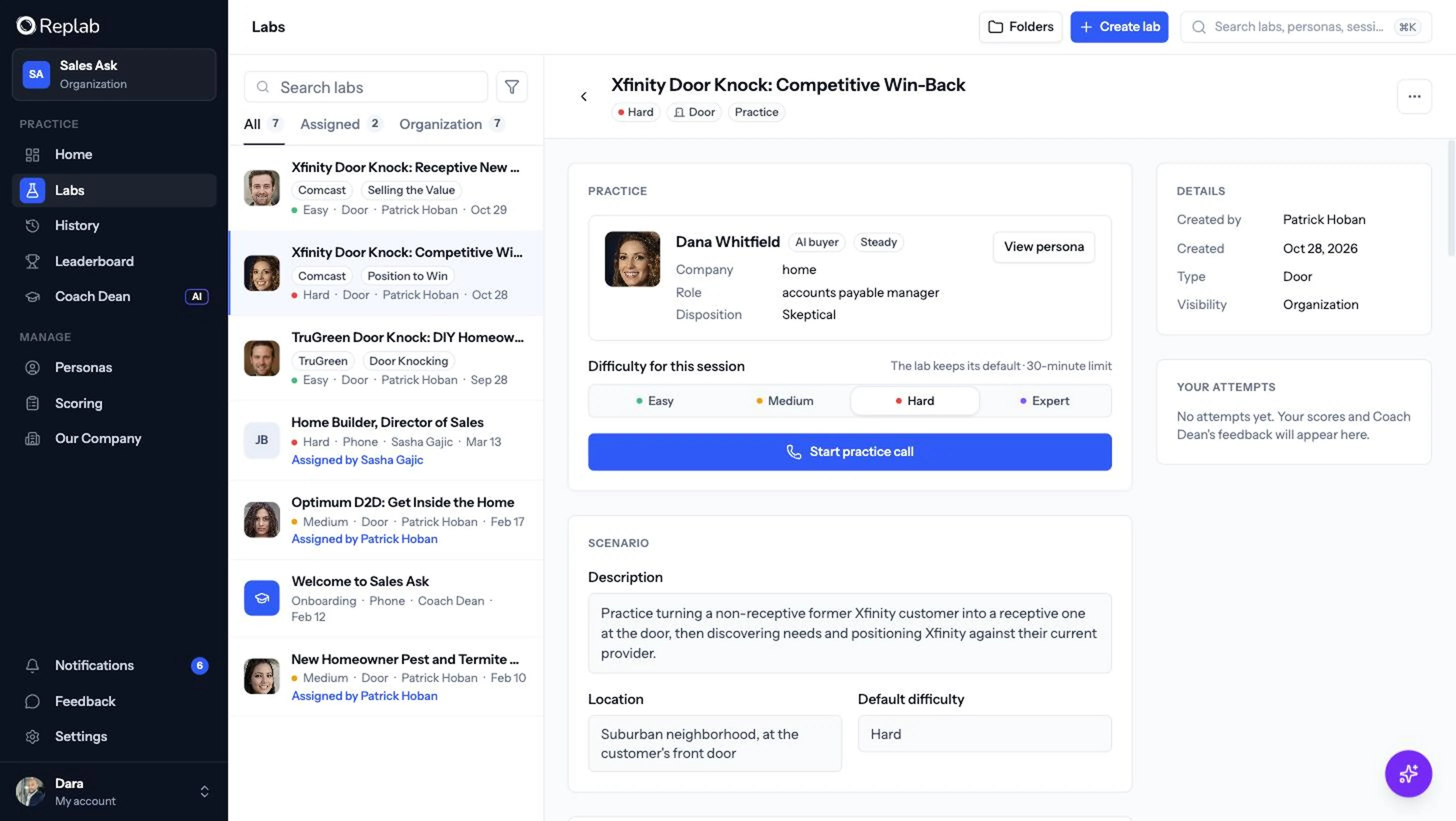
RepLab is a roleplay-first platform for sales and service teams in stores, branches, call centers and the field, which is the second, third and fourth row of the requirements table above. Reps talk out loud in a browser to an AI customer built from the team's own script, pricing sheet or a recording of a top rep, or chosen from 40 or more ready-made scenarios, with difficulty set from friendly to hostile and the first objection chosen by the manager. Most teams build their first custom customer in under ten minutes.
Every attempt is scored 0 to 100 on your own scorecard, criteria, weights and pass marks on every plan, with each criterion marked met or missed, time-stamped notes and one suggestion for next time. Reps retry until they clear the score goal. Managers see readiness by rep, team and location, a 30-day skill heatmap across opening, discovery, price, financing and close with Ready and Slipping flags, and can certify reps before they take live calls. Scores, readiness and certifications sync to Salesforce, HubSpot, Pipedrive, Aircall, JustCall, ServiceTitan, Housecall Pro and Jobber. Real customer conversations can be scored on the same scorecard through the SalesAsk add-on, which answers question eight on the demo list.
On the pricing questions: three plans, Team, Growth and Enterprise, priced per rep seat and quoted after a 30-minute demo. Managers and admins who review results are included and do not need a seat. The minimum is 10 rep seats, and the quote moves with rep count, how reporting is grouped by location, whether scenarios come from the library or your playbook, and integrations. Anyone can run a free roleplay against an AI customer before booking anything, and teams pilot on their own scenarios and scorecard.
It runs in English, Spanish and French. Security is SOC 2 Type I, GDPR, SSO and MFA, TLS in transit, AWS hosting, and conversations never train outside AI models. Where it falls short against the table: three languages against Second Nature's 30+, voice only with no video avatars, a 10-seat minimum, and no G2 reviews yet. Customers report 58% shorter new-hire ramp at Alliance Medical (12 weeks to 5), a 3x close rate on competitive deals there and 31% higher quoted job value at Coolforce; those are customer-reported figures with no control group, and the two-week plan above is how you get your own.
Frequently asked questions
What is sales roleplay software?
Software that plays the customer so a rep can rehearse a sales or service conversation, then scores the attempt and reports it to a manager. Four kinds are sold under the name: roleplay-first platforms, roleplay modules inside enablement suites, individual speech coaches and conversation-intelligence add-ons.
How much does sales roleplay software cost?
Most vendors quote after a demo. Yoodli is the exception with Pro at $8 a month and Advanced at $20 a month billed annually. Roleplay-first platforms price per rep seat on annual terms, with minimums around 5 seats at PitchMonster and 10 at RepLab, and real-call scoring is usually a separate license or add-on.
Do managers need a seat?
It depends on the vendor. RepLab includes managers and admins without a seat. Enablement suites usually count every user, and Allego's pricing page describes reduced rates for non-revenue roles rather than free ones. Ask before the quote, not after.
What is the single most important thing to test in a demo?
Load your own scorecard and weights and watch the platform score a real attempt. If the vendor cannot do that in the demo, the score it produces later will measure the vendor's idea of a good call rather than yours.
How long should an evaluation take?
Two weeks with five reps and one manager is enough, provided it runs on your scenarios and your scorecard. The plan above covers build time, score accuracy, variation between attempts, manager reporting, security and a like-for-like written quote.
Written by the RepLab team. Updated November 2026. RepLab is an AI roleplay platform for sales and service teams in stores, branches, call centers and the field, scored on your own scorecard.