
AI roleplay for customer service teams: how support agents practise the calls that decide retention
A support agent's first angry caller, first billing dispute and first cancellation should happen against an AI customer, scored on your QA form, with a pass mark they have to clear before a real customer is on the line. That is the whole idea of AI roleplay for customer service. This guide is for the team lead who has to make it work: eight scenarios worth building, why scoring tone and scoring outcome are different jobs, a 20-minute scenario from a real transcript, where certification sits next to nesting, and which numbers prove it did anything.
The eight customer service scenarios worth practising
Build these eight before anything else. Between them they cover the calls that produce complaints, churn, QA fails and escalations. Each row separates what the agent has to do from what the scorer should look for, because those are two different lists. An agent can do everything right on a policy refusal and the customer still hangs up angry, and an agent can save a cancellation by promising a credit they are not allowed to give.
For where to set the bar, RepLab's customer service page ships its sample scenarios with pass marks between 78 and 86 out of 100: Repeat caller at 84, Refund request at 80, Cancellation at 82, How-to question at 86, Delivery delay at 78 and Policy no at 80. Those are RepLab's defaults, so treat them as a starting point. The right mark for your team is roughly what your best three agents score on their first attempt.
The table does not settle order. We would run angry caller first, because every other scenario contains a version of it, and leave escalation handoff for last, since an agent who has not yet failed a few saves does not know what a handoff is for.
| Scenario | What the agent must do | What to score |
|---|---|---|
| Angry caller | Let the customer finish, name the problem back in their words, slow down, get to one next step | Interruptions, whether the problem was restated correctly, whether the call ended with a concrete action and a time |
| Billing dispute | Verify the account, explain the charge in plain words, offer what policy allows, confirm the timeline | Verification before discussing money, accuracy of the explanation, no promise outside policy (hard fail) |
| Cancellation save | Find the real reason before offering anything, match the offer to the reason, respect the decision if it stands | Did the agent ask why before offering, was the offer the right one for that reason, was the close clean either way |
| Outage apology | Apologize once, give the facts you have, give the next update time, do not speculate on cause or fix | Single apology, no invented cause, a stated update time, no blame passed to another team |
| Policy refusal | Say no clearly and early, explain the reason, offer the option that does exist | Was the no said in the first minute, was a reason given, was an alternative offered, no softening into a maybe |
| Upsell on a service call | Resolve the original issue first, tie the offer to something the customer said, accept the first no | Issue resolved before the pitch (hard fail if not), relevance of the offer, pushed after a no |
| Vulnerable customer | Spot the signs (confusion, distress, a third party speaking), slow down, follow the vulnerability process, record it | Signs noticed, process steps followed in order, no decision pushed on the call, correct note left |
| Escalation handoff | Decide quickly that this is a handoff, tell the customer what happens next, brief the receiver so the customer does not repeat the story | Time to the decision, accuracy of the handoff summary, whether the customer was told who, when and why |
Scoring for tone and scoring for outcome are two different jobs
Most QA scorecards score tone and process, and most of the numbers your director cares about are outcomes. The gap is well documented. SQM Group writes that 81% of agents' QA scores do not correlate with CSAT or FCR, and that only 19% of managers strongly agree their QA program helps improve CSAT. In a piece MiaRec's John Ortiz wrote for Call Centre Helper in May 2026, a MiaRec customer found that 31% of calls that passed internal QA ended with a customer rating the call dissatisfied or very dissatisfied. One agent in that piece scored 92%, stayed polite throughout, and never explained the pricing discrepancy the customer had phoned about.
So a roleplay scored on your existing QA form teaches agents to pass your existing QA form, which is worth something and is a different thing from teaching them to save a customer.
The fix is to score both and be explicit about which is which. Tone criteria are behaviours you can hear: no interruptions, a restatement of the problem, one apology rather than six, pace that drops when the customer's rises. Outcome criteria are states of the world at the end of the call: the charge was explained correctly, the right offer was made for the reason given, the customer knows what happens next and when. Outcome criteria go at the top of the scorecard with most of the weight. Tone criteria sit below with less, and one or two of them (arguing with the customer, promising something outside policy) become hard fails, because a hard fail is the only honest way to say that no amount of good tone rescues the call.
One caveat. On a cancellation save, do not score whether the simulated customer stayed. The AI customer is built to resist, and you want agents learning the steps that save real customers over a month rather than the line that makes this one persona give in. Score the steps. Count the saves on the floor.
How to write a scenario from a real transcript in 20 minutes
The best scenarios are lifted from a call that already went wrong. Here is the version a team lead can do on a Friday afternoon with one transcript and a blank document.
Minutes 0 to 5: pick the call. From this week's QA fails or the escalation log, choose a call where the agent did the process right and the customer still ended up angry, or one where the agent went off policy to make the customer happy. Those are the two failure shapes a roleplay fixes.
Minutes 5 to 10: write the customer, not the script. Four lines. Who they are and what happened before the call (charged twice, third call, order three days late). Their opening line, word for word from the transcript. Their mood, from tired to furious, and what makes it worse. The one thing that would satisfy them, and whether policy allows it. In RepLab this is where you paste the description in and it drafts the persona, objections and scoring for you to adjust; the product page says teams usually build a first custom customer in under ten minutes.
Minutes 10 to 15: write the scorecard from the transcript. Mark the three moments where the call turned. The agent said "I understand" and then explained policy without asking a question. The agent offered a credit before hearing the reason. Each turning point becomes one criterion a listener can check. Add one hard fail. Stop at five or six.
Minutes 15 to 20: set the pass mark by running it yourself. If you, with the full picture, land at 85, the pass mark for a new hire is 75 to 80. If you land at 95, the scorecard is too easy and needs a harder criterion. Assign it to the agent whose call it was first, and to the team on Monday.
Do not polish. A scenario lifted from one real transcript beats one written for a generic telco, because the opening line is one your agents have heard.
Certification before the queue, and where nesting still fits
Certification means an agent has passed a named set of scenarios at or above the pass mark before they take a live contact. For a support new hire the set is the eight above, or whichever six match your queue, each with its own mark. Passing is a condition of leaving the classroom, the way product knowledge used to be, except it is tested on a call rather than a quiz.
Nesting does not disappear. Call Centre Helper defines it as the period immediately after formal training when new agents handle live interactions under close supervision, leaving once they show consistent proficiency on performance metrics and confidence. What changes is what nesting is for. Without roleplay, nesting is where a trainee meets their first angry caller and the mentor's job is damage control. With certification first, the mentor opens the trainee's roleplay scores before the first shift, sees that this agent passed billing disputes at 88 and scraped policy refusals at 79 on the third attempt, and spends side-by-side time on refusals.
RepLab's one published customer figure on ramp is Alliance Medical, a sales team rather than a support floor, whose new-hire ramp fell from 12 weeks to 5 after certification became a condition of working alone; RepLab reports this as 58% shorter, and it is a customer figure published by the vendor. We do not yet have a support-floor equivalent to publish, which is a gap we would rather name than paper over.
Measuring the effect, and the mistakes that blur it
Four numbers tell you whether the program worked, and they move in order: QA score, CSAT, repeat contact, save rate. QA moves first because it measures the behaviours you scored. CSAT follows and needs a comparison group. Repeat contact is the one to watch hardest, since a call that sounded fine and did not resolve the issue comes back as another call; SQM Group reports a 0.70 correlation between FCR and CSAT and says every 1% gain in FCR tends to bring a 1% gain in CSAT. Save rate is the one finance asks about and the one most affected by the offer policy rather than the agent, so measure it per agent against the same offer set.
The public figures are vendor published, so read them that way. TELUS Digital's write-up of its Agent Trainer at a payments processor onboarding 90 new employees reports a 16% CSAT increase across all channels, 29% on chat, and 80% of an initial test group of underperformers moving to top performer, with no group size, timeframe or control group given. Qualtrics XM Institute's survey of 28,400 consumers, published in February 2024, found that consumers reduce or stop spending with a brand after 51% of bad experiences, which is the number to put next to your contact volume when someone asks why saves are worth rehearsing. On save rate, ProsperStack's case study on the Minnesota Star Tribune reports an 18.5% digital save rate; it is a vendor figure about an online cancellation flow rather than agents, and a reminder that a save rate without the offer set beside it means little.
To get a figure you can defend, take one new-hire class, compare it with the class before, and hold the comparison for eight weeks on all four numbers.
The mistakes that blur the result repeat on every floor:
Scoring the roleplay on a different form from the floor. Agents learn two games. Use the QA form and add the outcome criteria to it.
One pass mark for every scenario. A vulnerable customer scenario should fail on a missed process step however warm the agent sounded. A delivery delay chat can pass at 78 with a wobble in tone.
Building only from a vendor library. Agents can tell when the opening line is one nobody has ever said to them.
Letting the supervisor be the scorer. Team leads will not listen to 30 practice calls a week. The system scores; the lead reviews the bottom five.
Stale scenarios after a policy change. The refund rule changed in March and the scenario still allows the old credit. Whoever owns the knowledge base should own the scenario set.
How RepLab does it
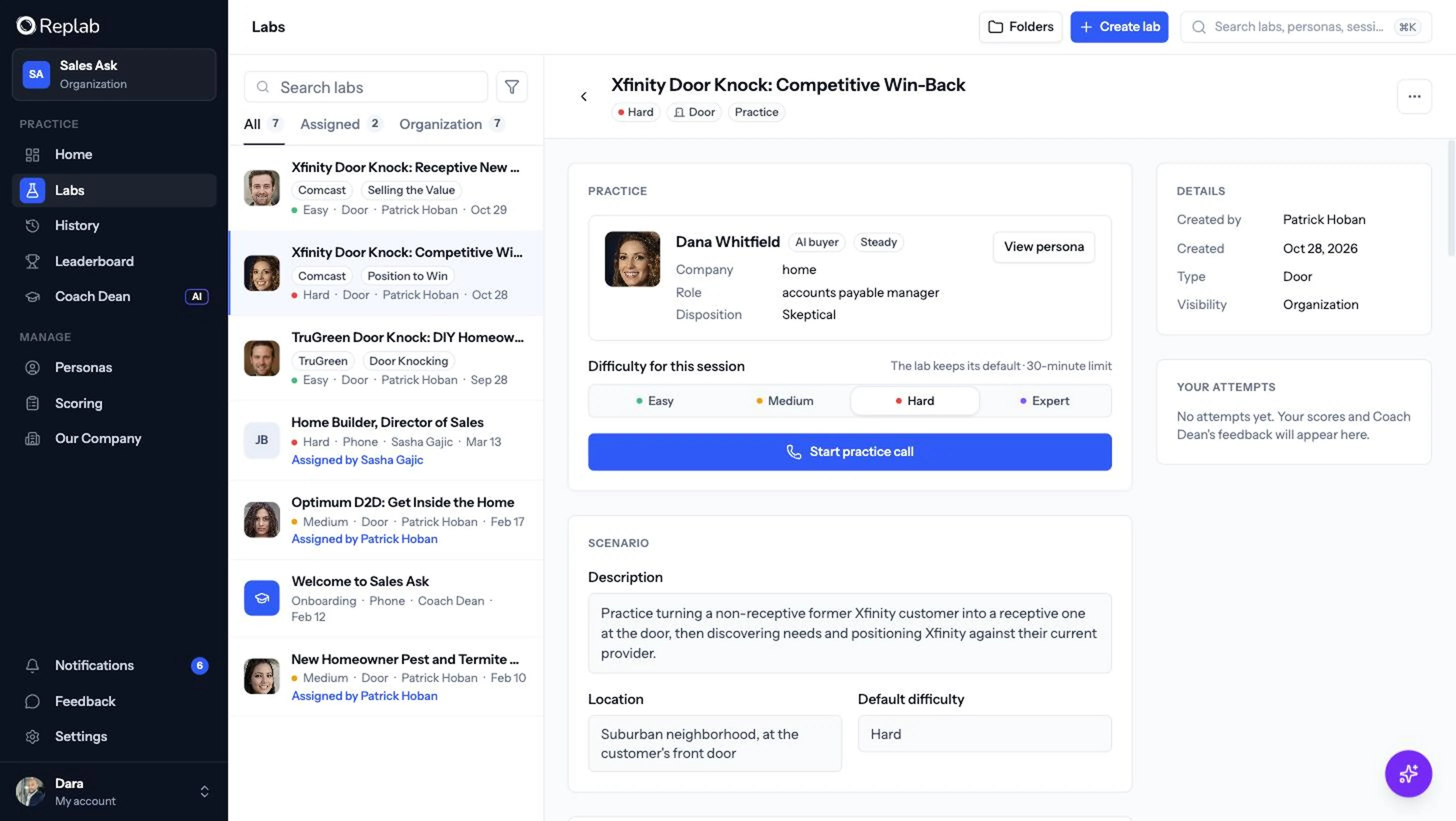
RepLab puts the agent on a voice, chat or email call with an AI customer built from your scripts, policies and call recordings, or from one of 40 or more ready-made scenarios, in English, Spanish or French. The customer interrupts, asks follow-ups and varies each session. Every attempt is scored 0 to 100 on your own scorecard with your weights and pass marks, with time-stamped notes and a suggestion for the next attempt, and agents retry until they clear the bar. You can write criteria yourself or paste in your QA form and let RepLab draft them, which is how the outcome and tone split above gets built in practice.
Team leads see readiness by agent, team and site in one view, with statuses like Certified, Practicing and Needs focus, and can assign a scenario to an agent whose score has slipped or to a whole class before a policy change goes live. Through SalesAsk, real calls are scored on the same scorecard and weak spots come back as the next drill. RepLab does not replicate your billing software or CRM screens; if the new hire's biggest gap is the system, that is a different product.
Plans are Team, Growth and Enterprise, priced per rep seat with managers and admins included and a 10-seat minimum, quoted after a 30-minute demo on your own scorecard. Security is SOC 2 Type I, GDPR, SSO and MFA, hosted on AWS, and conversations never train outside models. There is a free roleplay to try before anyone books a call.
Frequently asked questions
Which customer service scenarios should we practise first?
Angry caller first, because every other call contains one. Then billing dispute, cancellation save, outage apology, policy refusal, upsell on a service call, vulnerable customer and escalation handoff. Build each from one of your own transcripts rather than a vendor library.
Should we score tone or outcome?
Both, with outcome weighted higher and one or two tone behaviours as hard fails. SQM Group reports that 81% of agents' QA scores do not correlate with CSAT or FCR, which is what happens when a scorecard only checks process and tone.
How long does it take to build a scenario?
About 20 minutes from a real transcript: five to pick the call, five to write the customer, five to turn the call's turning points into criteria, five to set the pass mark by running it yourself. RepLab's product page says teams usually build a first custom customer in under ten minutes.
Does certification replace nesting?
No. Certification happens before the first live contact; nesting is the supervised live period after it. With certification first, the nesting mentor can see which scenarios the agent scraped through and spend side-by-side time there, so nesting gets shorter and targeted.
What results can we expect?
Vendor-published figures include TELUS Digital's 16% CSAT increase at a payments processor onboarding 90 new hires, with no control group given. The defensible number is your own: one class against the previous class, on QA score, CSAT, repeat contact and save rate, held for eight weeks.
Written by the RepLab team. Updated November 2026. RepLab is an AI roleplay platform for sales and service teams in stores, branches, call centers and the field, scored on your own scorecard.