
Call center simulation training: what works, what does not, and how to set it up
Simulation training works when agents take the hardest five or six call types against a scripted or AI customer, get scored on the QA form the floor already uses, and have to pass before they join the queue. It fails when it is a library of generic scenarios nobody is required to finish. This guide covers how simulation differs from nesting, which calls to simulate and what to score, the three kinds of product on the market, which numbers prove it worked, and how to run it for a class of new hires.
What simulation training is, and what nesting and side-by-side are not
Simulation training puts an agent in front of a fake customer, scripted or AI-driven, who behaves like the real one: interrupts, gets angry, asks for a refund the policy does not allow. The agent handles the call, the attempt is scored against criteria the trainer set, and the agent can run it again ten minutes later. No real customer is on the line, so the agent can fail safely and every new hire faces the same call.
Nesting is different. Call Centre Helper defines it as the period immediately after formal training when new agents take live calls with extra supervision, and says an agent leaves nesting once they show consistent proficiency on handling time, customer satisfaction and accuracy. Side-by-side (sometimes called buddying) is the mentor sitting next to the trainee during those live calls. ScreenSteps' write-up on shadowing and nesting puts the cost plainly: you are paying two people to do one job, and nesting can take days or weeks depending on call complexity.
The gap simulation closes is the one between the classroom and the first nesting call. In nesting, the customer decides what the trainee practices. If no billing dispute comes in during week one, the trainee does not practice billing disputes until a real one lands. Simulation reverses that. The trainer decides which calls the agent has to survive, and the agent has survived them before a customer is involved.
The five call types worth simulating first
Do not start with a library. Start with the five calls that generate escalations, QA fails and compliance findings, and build a scenario for each. Each row names what the scorer should look for and how to set the pass mark, which differs by call type. A compliance call should fail the moment a required disclosure is skipped, however good the rest was. A cancellation save should be scored on the steps, because reps who follow the steps save more over a month even when a single simulated customer still leaves.
For reference, RepLab's customer service page lists sample scenarios with pass marks between 78 and 86 out of 100 (Refund request at 80, Cancellation at 82, Repeat caller at 84), with the harder scenarios set lower because the scorecard is harder to score well on. The right number for your floor is whatever your top quartile agents score on their first attempt.
| Call type | What to score | Pass mark approach |
|---|---|---|
| Billing dispute | Verified the account before discussing charges, explained the charge in plain words, offered the options policy allows, did not promise a credit the agent cannot give | Weighted score; a hard fail on any promise outside policy |
| Cancellation save | Asked why before offering anything, acknowledged the reason, presented the retention offer in the right order, closed cleanly whether the customer stayed or left | Weighted score on the steps, not the outcome; same bar for every agent in the class |
| Angry caller | Let the customer finish, named the problem back, lowered pace and volume, did not argue or over-apologize, got to a next step | Weighted score; set the bar from what your best agents score on the same scenario |
| Compliance disclosure call | Every required disclosure delivered word for word and in order, identity verified, recording notice given, nothing added that creates a new obligation | All or nothing on the disclosures; score the rest separately |
| Upsell on a service call | Resolved the original issue first, earned the right to pitch, tied the offer to something the customer said, took no for an answer once | Weighted score; a hard fail for pitching before the issue was fixed |
Three kinds of product, and who each one suits
The market sells three different things under the words contact center simulation, and buying the wrong one is the most common setup mistake.
Desktop-embedded procedural simulators replicate the agent's software and let a new hire rehearse the workflow, screens included, while the call runs. Zenarate's Perform covers voice, chat, email, back-office work and software and screen tasks, and its TruGreen story credits it with new specialists reaching near-veteran proficiency in Microsoft Dynamics CRM in five days. SymTrain lists Voice, Screen and Chat simulation types and embeds practice inside Genesys, Verint and the LMS or QA tools a center already runs. Solidroad builds System Simulations, working replicas of a billing tool with fictional invoices and a refund form, and marks each step Passed or Missed. These suit large BPO and enterprise floors where the new hire's biggest gap is the system, and they take the longest to set up, since someone has to model your software.
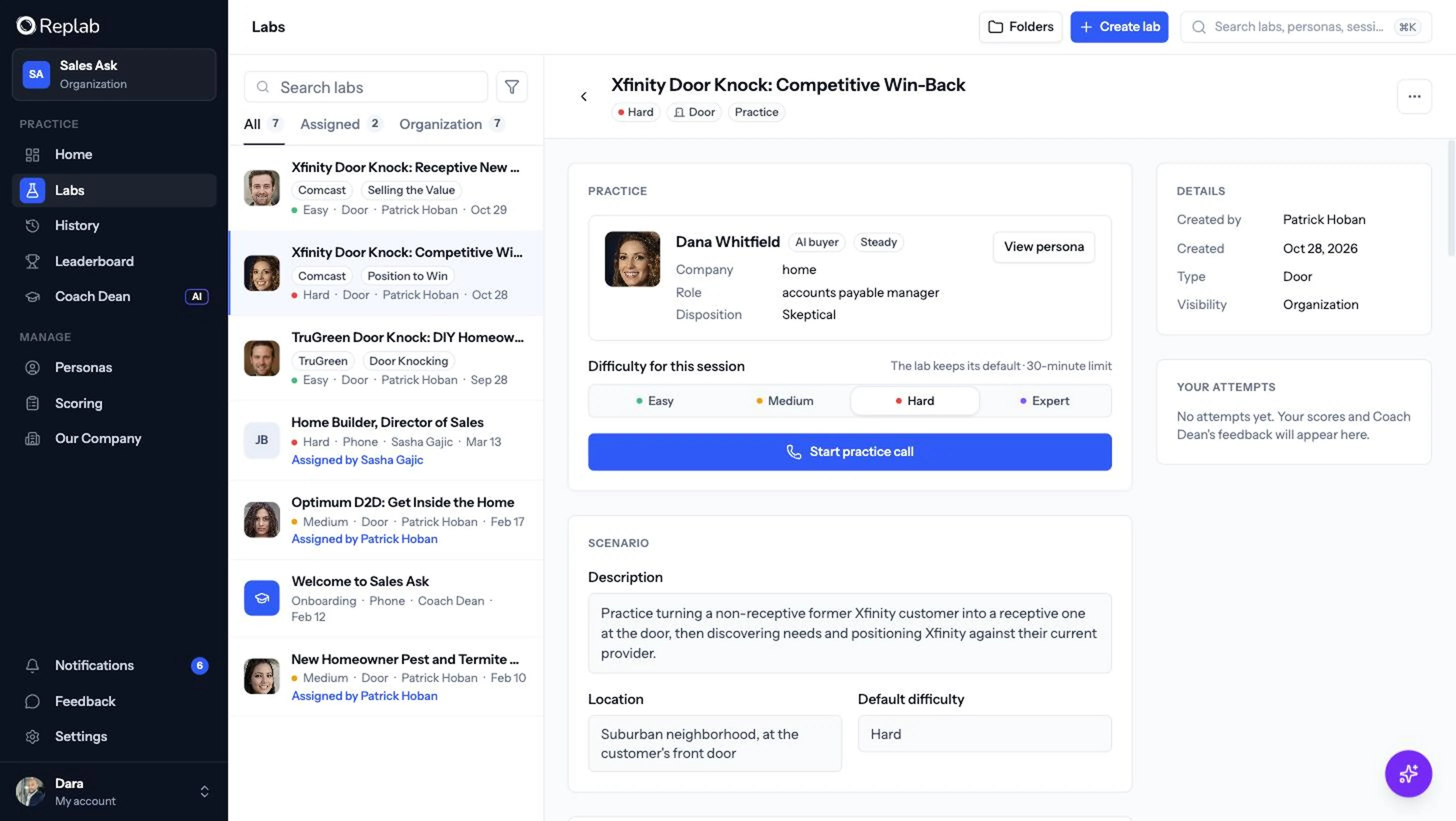
Voice AI roleplay puts the agent on a live call with an AI customer and scores the conversation. RepLab builds the AI customer from your scripts, policies and call recordings, or from 40 or more ready-made scenarios, and scores every attempt 0 to 100 on your own scorecard. ReflexAI's Prepare does something similar in 25 or more languages, with personas built in its Studio from a file, script or prompt, and Solidroad's conversation simulations run over chat, email, phone and video in 90 or more languages. This type suits any center whose problem is the conversation itself: tone, de-escalation, the save, the disclosure. A manager can turn last week's worst call into a scenario in an afternoon.
QA-linked simulators close the loop between live calls and practice. ReflexAI's Assure scores every real call, chat and message and can turn a flagged interaction into a personalized simulation. Zenarate's Analyze runs your existing QA scorecard across every interaction instead of a sample. SymTrain's Connected Coach lets a QA miss or a KPI dip assign a practice scenario automatically. RepLab does this through SalesAsk, which scores real calls on the same scorecard as the roleplay and sends weak spots back to practice. One caution from this year: Solidroad retired its QA product in September 2026 and now sells training only, which is a reminder to ask any vendor which half of the loop they intend to keep.
How to tell whether it worked
Four numbers, in this order of trust: QA score, average handle time, CSAT, and time to proficiency. QA score moves first, because it measures the behaviors the simulation scored. AHT moves next, usually within the first two months. CSAT is noisier and needs a comparison group. Time to proficiency is the number the budget owner cares about, and the one most programs never define.
The cleanest public example is IntouchCX's case study on an unnamed major US retailer, published by IntouchCX, so treat it as a vendor claim. New hires who used its AI roleplay tool averaged a 7% CSAT improvement in their first four weeks compared with non-users. QA scores rose by an average of 4%. AHT fell by 9 seconds immediately and a further 5 seconds on average after eight weeks, and new hires hit the center's existing 400-second AHT benchmark by week 11. The study gives no group sizes, no baselines and no description of how the non-user group was chosen. It still compares users to non-users in the same period, which most case studies skip.
The other vendor figures in circulation are self-reported by the vendor or its customer on the vendor's site. Zenarate names Blue Cross and Blue Shield of Minnesota at 60 or more seconds off average handling time, Sallie Mae at 32% lower employee attrition, and TruGreen at onboarding time cut 50%. Solidroad says Crypto.com saw 18% lower average handling time and Podium cut new-hire ramp time in half. SymTrain reports 0% attrition at Working Solutions for a practicing group versus 35% for a group that did no practice. RepLab's own figure is Alliance Medical, a 45-rep team whose ramp fell from 12 weeks to 5 after new hires had to pass 15 scenarios with minimum scores before working alone, which the company reports as a 58% shorter ramp.
To get a number you can defend internally, pick one class, split it or compare it to the previous class, define proficiency as a fixed QA score plus an AHT ceiling held for two consecutive weeks, and count the days from day one of training to that point.
Rolling it out for one class, and the mistakes that sink it
Run the first rollout on a single new-hire class, not the floor. A class has a start date and a go-live date, which gives you a before and after for free.
Week one of training is classroom and product knowledge as it was before. From week two, each agent runs the five scenarios above, in order of difficulty, with the scorecard visible before the first attempt. Set a certification bar for each scenario, and make passing all five the condition for entering nesting. Expect three to five attempts per scenario for the harder ones. Have the trainer review only the lowest-scoring attempts. Keep nesting, but shorter, and have the nesting mentor pull the agent's roleplay scores before the first live shift so the side-by-side time goes to the one call type that agent kept failing.
The mistakes are consistent across centers:
Buying a scenario library and calling it a program. Agents open it once. The scenarios that matter are the ones built from your policies and your recorded calls, and the ones agents are required to pass.
Scoring on vibes. If the scorecard for the simulation differs from the QA form on the floor, agents learn to pass the simulation and still fail QA. Use one scorecard, and let QA leads own it.
No pass mark, or one pass mark for every call. A compliance call and a cancellation save need different rules, as the table above shows.
Skipping the comparison group. Without the previous class or a split class, the result becomes a vendor slide nobody trusts.
Making supervisors run it. Team leads will not sit through 20 roleplays a week. The program has to score itself and surface only the attempts a human should look at.
Letting the scenarios go stale. The script changed in March and the simulation still practices the old one. Assign someone to own the scenario set the way someone owns the knowledge base. Zenarate pitches authoring agents that rebuild a simulation when a policy document changes; whichever tool you use, the change has to reach the scenario within the week.
How RepLab does it
RepLab is the voice AI roleplay type with the QA loop attached. Agents rehearse escalations, refunds, cancellations and the third transfer against an AI customer built from your policies, scripts and call recordings, or from one of 40 or more ready-made scenarios, over voice, chat and email, in English, Spanish and French. Every attempt is scored 0 to 100 on your own scorecard, with your weights and pass marks, and team leads see readiness by agent, team and site in one view so a whole class can certify before go-live. Through SalesAsk, real calls are scored on the same playbook and weak spots go back to practice.
It does not simulate your billing software or your CRM screens. If a new hire's biggest problem is the system rather than the conversation, Zenarate, SymTrain or Solidroad cover that and RepLab does not.
Pricing is per rep seat with managers and admins included, plans are Team, Growth and Enterprise, the minimum is 10 seats, and you get a quote after a 30-minute demo on your own scorecard. Security is SOC 2 Type I, GDPR, SSO and MFA, hosted on AWS, and conversations never train outside models. You can run a free roleplay before anyone books a call.
Frequently asked questions
How is simulation training different from nesting?
Nesting is live calls with a mentor nearby, and the customer decides which calls the trainee practices. Simulation is a fake customer the trainer controls, so every agent faces the same hard calls before a real one is on the line. Most centers run simulation first and keep a shorter nesting period after it.
Which calls should we simulate first?
The five that drive your escalations and QA fails: billing dispute, cancellation save, angry caller, compliance disclosure and the upsell on a service call. Build those from your own policies and recorded calls before touching a vendor library.
What pass mark should we use?
Set it from what your best agents score on the same scenario on their first attempt, and use a different rule per call type. Compliance disclosures are all or nothing; a cancellation save is scored on the steps, not whether the simulated customer stayed.
Does simulation training actually move AHT and CSAT?
The best public figure is IntouchCX's case study of a US retailer: a 7% CSAT improvement in the first four weeks against non-users, QA up 4% on average, and AHT down 9 seconds immediately. It is vendor-published and gives no group sizes, so run your own comparison against the previous class.
Do we need the version that simulates our software?
Only if the new hire's biggest gap is the system. Zenarate, SymTrain and Solidroad replicate the agent desktop; RepLab and ReflexAI focus on the conversation and score it on your scorecard. Centers where the failure is tone, the save or the disclosure rarely need the screen simulation.
Written by the RepLab team. Updated November 2026. RepLab is an AI roleplay platform for sales and service teams in stores, branches, call centers and the field, scored on your own scorecard.