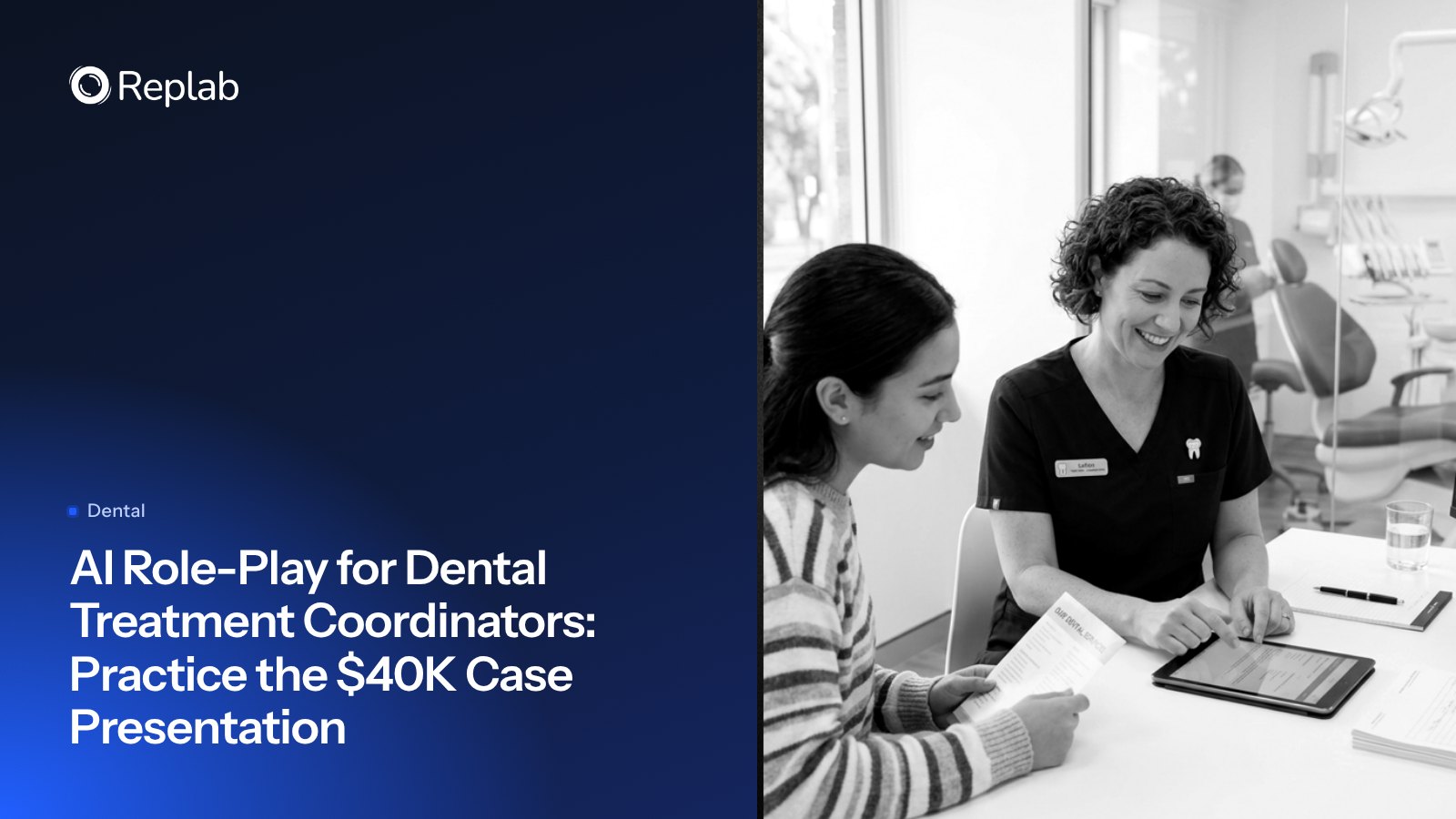
A treatment coordinator usually gets one shot at a big case, with a nervous patient, minutes after the dentist leaves the room. AI role-play lets a TC rehearse that conversation, including the price pushback and the “I need to think about it”, as many times as it takes before a real patient hears it.
That is the whole idea. The rest of this post covers which moments to rehearse, how to set it up across several practices, and where it stops helping.
The diagnosis is done. The patient has just heard they need implants, a full arch, or a crown they did not budget for. They are holding clinical information, a number and a bit of fear at the same time. The TC’s job is to turn that into a decision.
Most TCs learn this by shadowing. They sit in on a colleague’s presentations for a few weeks, then start doing it themselves. Some pick it up fast. Others learn on live patients, and every case they fumble is treatment that was diagnosed and never done.
In RepLab, a scenario is built around one moment, with an AI patient who reacts to what the TC actually says. These are the ones dental teams usually start with:
Each session is scored 0 to 100 against the practice’s own criteria, and the feedback points to the exact line to try next time. A TC can run the financing scenario ten times in a week without taking a minute of a manager’s day.
RepLab is voice-first. The TC talks out loud, on a phone or a desktop, the way they will in the room. A private consultation room is quiet and predictable, which makes it one of the easier conversations to rehearse realistically. A busy front desk is harder.
For a DSO, the problem is rarely one weak TC. It is that every acquired practice trained its coordinators differently. One office mentions financing on every case, another almost never does.
The fix is the same scenarios and the same scorecard everywhere. New TCs complete a certification set before presenting to real patients, with minimum scores you choose. Managers see readiness by practice and by person, so a regional lead can spot that one location keeps skipping the financing step and assign practice on exactly that.
Role-play builds the skill. It won’t fix a fee schedule patients can’t afford, a diagnosis the patient doesn’t trust, or a schedule that leaves the TC three minutes per case. If acceptance is low for every TC in a practice, look there first.
If it is low for some TCs and fine for others, that gap is a conversation problem, and conversations can be practiced. See a dental scenario in RepLab.